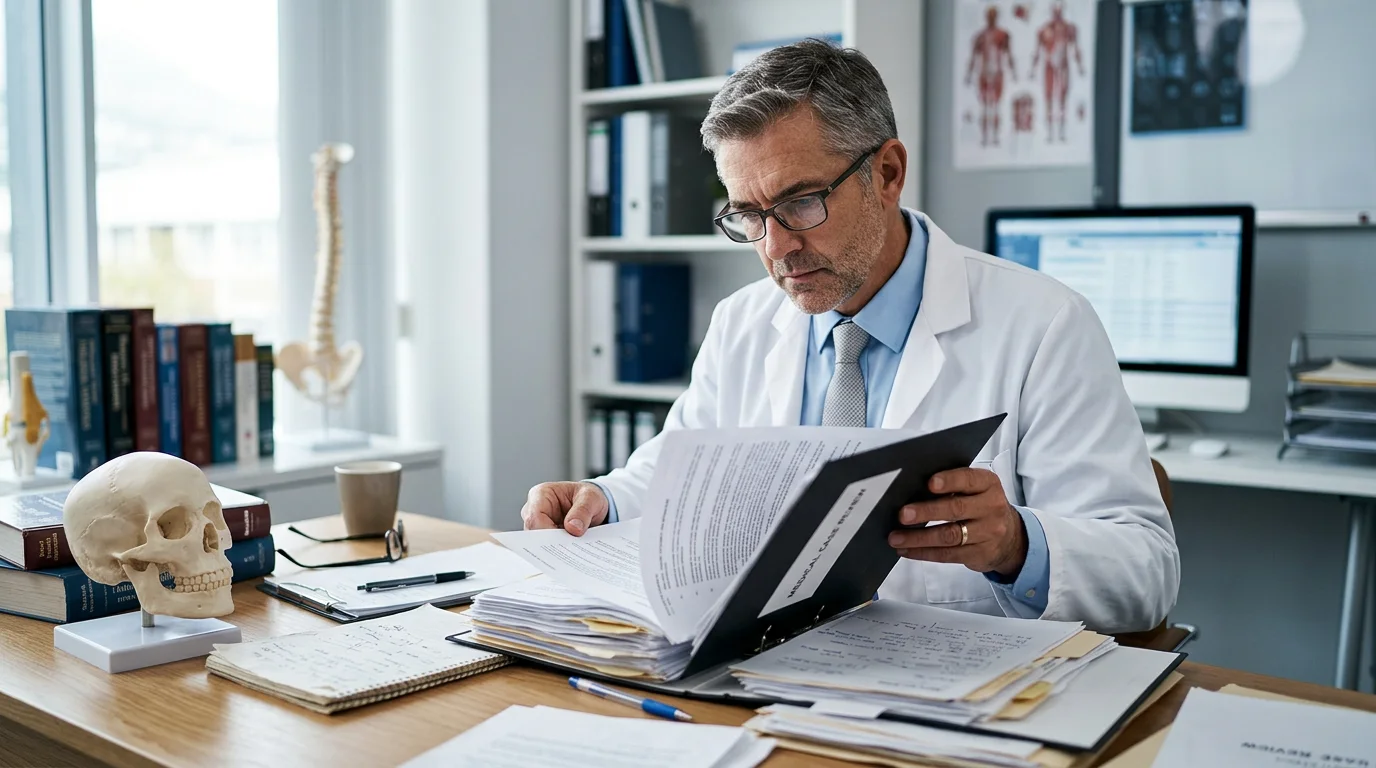
A clinical negligence claim stands or falls on its medical evidence. A solicitor can plead the facts, but the questions a court actually has to answer are medical ones: did the treatment fall below a reasonable standard, and did that failing cause the harm the claimant suffered? Neither can be settled by the claimant's account or the treating team's records alone. Both need an independent expert who examines the claimant, reads the records and gives an opinion the court can rely on.
Expert Medical Examination is an independent medical reporting organisation (MRO). We prepare the reports that answer those questions for solicitors handling clinical negligence claims. We provide the medical evidence; we do not give legal advice or run the claim.
Two questions the evidence has to answer
English law splits clinical negligence into two parts, and an expert report has to deal with both. The first is breach of duty. The test comes from Bolam and was refined in Bolitho: treatment is not negligent if a responsible body of medical opinion would have supported it, provided that opinion stands up to logical scrutiny. An expert in the same specialism has to say whether the care given fell outside that range.
The second is causation. Even where care was substandard, the claim only succeeds if that failing caused the injury. A delayed cancer diagnosis, for example, is only actionable if the delay changed the outcome. An expert has to separate the harm caused by the alleged negligence from the harm the underlying condition would have caused anyway. This is where many claims are won or lost, and it is the part a general narrative rarely gets right.
What an independent examination adds
The medical records tell you what happened. They do not tell you how the claimant is now, what their prognosis is, or what care and support they will need for the rest of their life. An independent examination captures that. It documents the current condition, the functional limits, the pain, and the realistic recovery, and it does so through the eyes of an expert whose duty is to the court rather than to either side.
That independence is the point. Under CPR Part 35, an expert's overriding duty is to the court, not to the party paying the fee. The report carries the declarations Part 35 requires, and it has to withstand questions from the other side and, in a contested case, cross examination. A report that reads as an advocate's document rather than an impartial opinion is worth very little, however favourable it sounds.
The right expert for the injury
Clinical negligence spans every specialism in medicine. An obstetric injury during birth, a missed fracture in A and E, a surgical error, a medication mistake, a delayed referral: each needs an expert who works in that exact field. An orthopaedic surgeon should not be opining on an obstetric standard of care, and a court will notice if they do. Matching each instruction to a genuine specialist is not administrative detail. It is what makes the opinion admissible and persuasive.
Why the quality of the report matters
A clinical negligence case can run for years and involve several parties, so weak evidence is expensive. Gaps, inconsistencies or opinions that stray outside the expert's field give the defendant something to attack, and they slow everything down. A clear, well reasoned report does the opposite. It sets out the standard of care, whether it was met, what the breach caused, and what the claimant now faces, in language a judge and a solicitor can follow without a medical dictionary.
How Expert Medical supports clinical negligence claims
We work with solicitors across England and Wales. We match each instruction to a GMC or HCPC registered expert in the relevant specialism, arrange the examination close to the claimant, and check every report for CPR Part 35 compliance before it is delivered. The aim is simple: independent medical evidence a court can rely on, prepared to the standard the court expects.
If you are handling a clinical negligence claim and looking for a medical reporting organisation (MRO), our panel and reporting process are built for exactly this work. Speak to us about an instruction and we will match it to the right expert.